
Insights
Cell Division as a Model for Role Design & Cost Reduction in a Growing Organization
Biology defaults to what works. Evolutionary biology and survival of the fittest make it so.
At the most fundamental level, growth in most living systems is not primarily driven by reproduction in the way we typically think about it; two organisms producing a third. Instead, growth is largely driven by duplication and division at the cellular level. A single cell replicates its internal components, copies its genetic material, and divides into two independent cells. This process, called mitosis, is the baseline mechanism for growth, repair, and survival.
The mechanics are straightforward but precise. A cell first increases in size and duplicates its internal machinery. It then replicates its DNA, ensuring that each future cell will have a complete set of instructions. Finally, it divides, allocating resources, organelles, and genetic material into two functional units. Each resulting cell is viable on its own, capable of performing the full set of functions required for survival while also doubling the probability of survival from the onset.
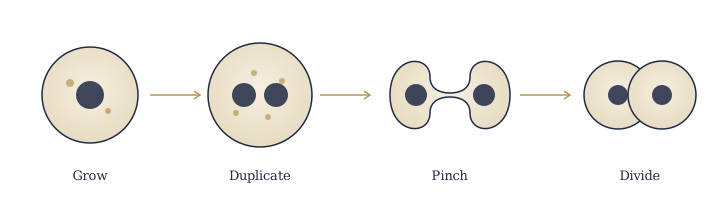
This process is efficient for a few reasons.
First, it preserves continuity. Each new cell inherits a proven operating system, the same genetic code that allowed the parent cell to function. There is no reinvention required.
Second, it minimizes coordination cost. Unlike reproduction between two organisms, which requires synchronization, compatibility, and timing, cell division is internally controlled. It scales without dependency on external alignment.
Third, it allows for controlled specialization over time. While the initial duplication produces identical cells, environmental pressures and signaling pathways can later differentiate those cells into more specialized roles.
In aggregate, this becomes the dominant growth mechanism because it balances fidelity, efficiency, and adaptability. It is not just a way to grow, it is the most reliable way to grow without introducing unnecessary complexity.
Organizations, particularly growing ones, tend to default in the opposite direction.
Instead of dividing roles, they often stretch them. A single individual accumulates responsibilities over time, initially because it is efficient, later because it is convenient. What begins as a well-scoped role becomes a composite of multiple functions: execution, management, strategy, coordination. For a period, this works. The "cell" grows larger.
But there is a limit to how large a single cell can become before it becomes inefficient. It also creates a single point of failure.
In biology, this limit is governed by surface-area-to-volume constraints and the ability to move resources internally. In organizations, the constraint is cognitive bandwidth and time. As a role expands, the marginal effectiveness of that individual declines—not necessarily because of capability, but because the structure of the role becomes inefficient.
At that point, the correct response is not to continue stretching the role. It is to divide it.
Role division in an organization mirrors cell division more closely than it might initially appear.
Before division, there is a preparation phase. Responsibilities are clarified, processes are documented, and implicit knowledge is made explicit. This is analogous to the duplication of internal components and genetic material. Without this step, division results in failure, one or both roles lack the information required to function independently.
Then comes the division itself. A single role becomes two (or more), with responsibilities allocated between them. Ideally, each new role is coherent, capable of operating with a clear mandate and minimal ambiguity.
The result is not just redundancy. It is scalability. There are two common scenarios where this becomes necessary.
The first is cost-driven division. A role evolves to include responsibilities that do not justify the cost of the individual performing them. A senior hire may be executing work that can be performed by more junior talent at a fraction of the cost. In this case, dividing the role allows the organization to reallocate high-value activities to the senior individual while distributing lower-leverage tasks to less expensive resources. This is not a reflection of performance. It is a reflection of role economics.
The second is growth-driven division. As the organization scales, the volume and complexity of work increase beyond what a single individual can handle effectively. Here, division allows for layering, introducing more junior individuals beneath a senior operator. The senior individual shifts toward higher-order responsibilities: oversight, decision-making, and system design.
The junior individuals absorb execution and develop over time.
In both cases, the underlying principle is the same: the role, not the person, has reached its limit.
It should be noted that most functions in most organizations more closely mirror that of single celled organisms, they are relatively streamlined and simplified in their function. It is more common than not that the person should not be promoted with more responsibility but instead stay at their current expense level. Social pressure often results in promotion and wage inflation for managers not dexterous enough prevent this. Said another way, it's often cheaper to replace the person over time as well when a function needs to divide rather than create lopsided responsibility relative to the new entrant.
A useful illustration of this dynamic appears in hiring functions.
A common heuristic is that one HR professional can support approximately 100 employees. A healthy proxy near Dunbar's Number. In a stable environment, this ratio holds reasonably well. But the assumption embedded in that ratio is low volatility—predictable hiring, low turnover, and steady-state operations. Once those conditions change, the model breaks.
If turnover increases, even modestly, the workload expands non-linearly. Recruiting, onboarding, and backfilling introduce additional cycles of work. At 10% above industry-average turnover, the effective requirement can shift materially, often to the equivalent of 1.5 to as many as 4.5 HR professionals per 100 employees, depending on the intensity of hiring and replacement needs.
What changed was not the capability of the HR function. It was the environment in which it operates.
In biological terms, the organism entered a different ecosystem, one with higher demands for regeneration and adaptation. The appropriate response is not to push the existing "cell" harder. It is to increase the rate of division.
This principle generalizes beyond HR.
Sales organizations divide roles into prospecting and closing as volume increases. Finance teams separate accounting from FP&A as complexity grows. Operations functions split execution from optimization. In each case, the initial combined role is efficient at small scale, but becomes a bottleneck at larger scale.
The failure mode is consistent: organizations delay division too long.
They interpret strain as a performance issue rather than a structural one. They attempt to solve for output by increasing effort instead of adjusting design. Over time, this leads to degradation, missed opportunities, slower decision-making, and reduced quality.
Biology does not make this mistake. Cells divide before they fail, not after.
The rate of division is not arbitrary. It is determined by the demands of the surrounding system. In an environment with rapid growth or high turnover, division must occur more frequently. In a stable environment, it can occur more slowly. But in all cases, the mechanism remains the same: replicate what works, divide when necessary, and allow specialization to emerge over time.
For organizations, this suggests a simple operating model.
Roles should be designed with the expectation that they will eventually divide. Systems and processes should be built in a way that allows for replication. And leadership should view role strain as a signal, not of individual limitation, but of normal, structural evolution.
Growth, in this sense, is less about adding capacity and more about organizing it correctly. Biology solved this problem early. The model is available to simply copy from nature.

More From Thesis
Related Insights
Insights
The Role of a CEO - Part I - Fundamental(s)
What is a CEO actually being paid to do? Three economists who explained why companies exist offer a clearer answer than most modern leadership writing.
Insights
The Role of a CEO - Part II - Limit Theory
A CEO must operate in the limit. Strategy, cost, talent, capital, and character all show non-linear returns at the extreme — the middle is where firms die.
Insights
The Role of a CEO - Part III - Being The Best CEO
What does it take to be the best CEO? The answer runs through Buffett, Musk, the Greek know thyself, and Aristotle — older and simpler than the literature.